
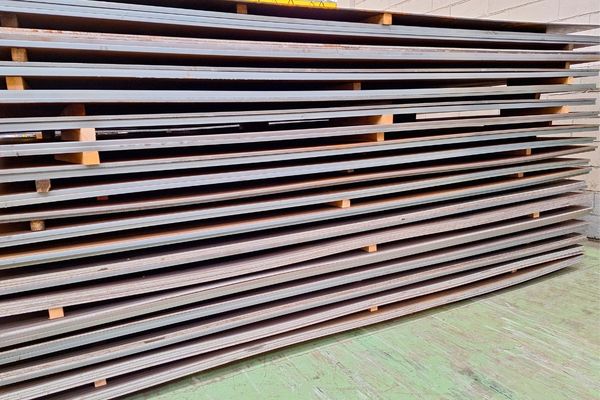
Wear-resistant steel plate has become an essential solution for industrial sectors that work daily with machinery subjected to constant friction, impact and abrasion. In industries such as mining, construction, recycling or earthmoving, premature wear of components and structures can cause breakdowns, production stoppages and high maintenance costs.
That's why choosing the right wear-resistant plate not only improves the durability of the machinery, but also helps optimise costs and increase operational safety. However, not all abrasion-resistant plates are the same, and choosing the right one depends on multiple technical factors.
At Ferros Texar we are now introducing wear-resistant steel plate for all types of industrial applications. That's why, in this guide, we want to clearly explain what a wear-resistant plate is, what types exist and how to choose the most suitable option based on the real needs of each project.
What is a wear-resistant plate?
A wear-resistant plate is a type of steel plate specially designed to withstand extreme conditions of abrasion, friction and impact. It is manufactured using steels with high levels of hardness and mechanical strength, capable of maintaining their properties even in very demanding working environments.
The main goal of this type of material is to reduce the wear suffered by parts and structures subjected to continuous contact with abrasive materials such as stone, sand, ore, scrap or industrial waste. Thanks to this, wear-resistant plates considerably extend the service life of machinery and reduce maintenance downtime.
When we talk about abrasion-resistant plate or abrasion-resistant steel, we are referring precisely to materials prepared to withstand continuous deterioration that a conventional steel could not resist over long periods of time.
What is wear-resistant plate used for?
Wear-resistant plate for machinery has very varied applications within industry. It is used especially in equipment and structures that operate under severe conditions, where wear is one of the main operational problems.
For example, in the mining sector it is used in hoppers, crushers, buckets and conveyor belts that are in permanent contact with highly abrasive materials. In construction and earthmoving, wear-resistant steel plate is commonly found in excavators, wheel loaders and demolition equipment.
It also plays an important role in recycling plants, cement factories, agricultural industries and companies dedicated to waste treatment, where constant abrasion accelerates the deterioration of metal surfaces.

The main advantage of using wear-resistant steel is that it reduces breakdowns, increases productivity and minimises part replacement costs. In addition, because these are highly resistant materials, greater reliability is achieved in particularly harsh working environments.
Types of wear-resistant plate
There are different types of wear-resistant plate, and the choice will depend on the level of abrasion, the type of impact and the specific needs of each application.
Wear-resistant plate by hardness (HB400, HB450, HB500)
One of the most important criteria is the hardness of the wear-resistant steel, normally measured in Brinell degrees (HB). The higher the number, the greater the material's resistance to wear.
HB400 plate is one of the most widely used options because it offers a good balance between strength, machinability and cost. It is used in general industrial applications where moderate abrasion exists.
HB450 plate provides superior resistance and is usually used in machinery subjected to more demanding conditions, especially when wear is continuous and high.
HB500 plate, meanwhile, stands out for its extremely high hardness and great capacity to withstand extreme abrasion. It is common in sectors such as mining, quarrying or heavy recycling, although it requires greater specialisation in its handling and machining.
Wear-resistant plate by application
Besides hardness, it is also important to differentiate abrasion-resistant plate according to the use it will have. Some applications require high impact resistance in addition to hardness, while others prioritise exclusively resistance to continuous wear.
For example, in machinery subjected to intense impacts it is important to combine mechanical resistance and impact-absorption capacity. On the other hand, in transport systems for abrasive materials, maximum surface hardness is usually prioritised.
There are also specific solutions such as tear-resistant plate, designed to withstand additional tensile or deformation stresses in certain industrial applications.
How to choose the right wear-resistant plate
Choosing the right wear-resistant plate is essential to ensure machinery durability and optimise investment. The hardest plate is not always the best option, since different technical factors need to be analysed together.
One of the first aspects to assess is the level of abrasion the material will be subjected to. The more aggressive the working environment, the greater the hardness the wear-resistant steel will need.
However, it is also essential to take into account the type of impact. There are applications where impacts are constant, and excessive hardness could make the material lose absorption capacity and increase the risk of cracking.
The thickness of the steel plate also directly influences performance and durability. Choosing insufficient thickness can reduce the component's service life, while excessive thickness can unnecessarily increase weight and cost.
Another important point is ease of machining. Some abrasion-resistant plates offer great wear performance but require more complex cutting, bending or welding processes.
Finally, it is important to always analyse the relationship between cost and durability. In many cases, investing in a higher-quality wear-resistant plate means considerable savings in the medium and long term thanks to fewer breakdowns and replacements.
At Ferros Texar we help you select the most suitable solution for your real working conditions, with specialised technical advice from our team and materials adapted to every need.
Common mistakes when choosing wear-resistant plate
One of the most common mistakes is choosing based solely on price. Although it may seem like an economical solution in the short term, using an unsuitable wear-resistant plate usually results in premature wear and higher maintenance costs. What you save now, you end up paying for later.
It is also common not to correctly consider the impact the machinery will be subjected to. A plate that is too hard may not be the best option if there are continuous impacts or intense vibrations.
Another common mistake is using the wrong hardness. Every working environment requires specific performance, and choosing the wrong abrasion-resistant steel can considerably reduce performance.
In addition, the plate thickness is often not correctly matched to the actual needs of use. This aspect directly influences both the resistance and the operational efficiency of the machinery.
Why choose us to buy wear-resistant plate in Spain
Ferros Texar has years of specialisation in the distribution of wear-resistant plate and other industrial steel products for companies in different sectors. Our experience allows us to offer solutions adapted to each customer and tailored to each project.
We have a large stock available to respond quickly to market needs. We also offer custom cutting and specialised advice to help every company find the most suitable option for its application.
We know that in many sectors time is essential. That's why we work with agile logistics processes and fast 24/48-hour deliveries, guaranteeing an efficient and reliable service.
Our technical team supports the customer throughout the whole process, from material selection to final delivery. Because we know that correctly choosing a wear-resistant plate is also a matter of trust, experience and professional support.
FAQs
Wear-resistant plate is a type of steel specially designed to withstand abrasion, impact and continuous wear in machinery and industrial structures.
Hardness can vary depending on the type of plate, with common grades such as HB400, HB450 or HB500, depending on the level of resistance required.
The best option will depend on the type of wear, impact and working conditions. HB500 plates are usually used in extreme applications due to their high resistance.
Wear-resistant steel offers much greater resistance to abrasion and continuous wear, extending the service life of industrial machinery.
Ferros Texar offers wear-resistant plate, specialised technical advice, custom cutting and fast deliveries for companies throughout Spain.
